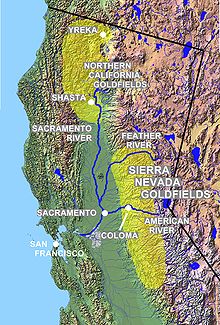
The Gold Rush started at Sutter's Mill, near Coloma.[3] On January 24, 1848 James W. Marshall, a foreman working for Sacramento pioneer John Sutter, found pieces of shiny metal in the tailrace of a lumber mill Marshall was building for Sutter, along the American River.[4] Marshall quietly brought what he found to Sutter, and the two of them privately tested the findings. The tests showed Marshall's particles to be gold. Sutter was dismayed by this, and wanted to keep the news quiet because he feared what would happen to his plans for an agricultural empire if there were a mass search for gold.[5] However, rumors soon started to spread and were confirmed in March 1848 by San Francisco newspaper publisher and merchant Samuel Brannan. The most famous quote of the California Gold Rush was by Brannan; after he had hurriedly set up a store to sell gold prospecting supplies,[6] Brannan strode through the streets of San Francisco, holding aloft a vial of gold, shouting "Gold! Gold! Gold from the American River!"[7] With the news of gold, many families trying their luck at Californian farming decided to go for the gold, becoming some of California’s first miners.
At this time, California was not a state of the Union, but rather part of the state of Alta California in Mexico. Shortly afterward, this region and the rest of Alta California was ceded to the U.S. after the end of the Mexican-American War with the signing of the Treaty of Guadalupe Hidalgo signed on February 2, 1848.
On August 19, 1848, the New York Herald was the first major newspaper on the East Coast to report that there was a gold rush in California; on December 5, President James Polk confirmed the discovery of gold in an address to Congress.[8] Soon, waves of immigrants from around the world, later called the "forty-niners," invaded the Gold Country of California or "Mother Lode." As Sutter had feared, he was ruined; his workers left in search of gold, and squatters invaded his land and stole his crops and cattle
